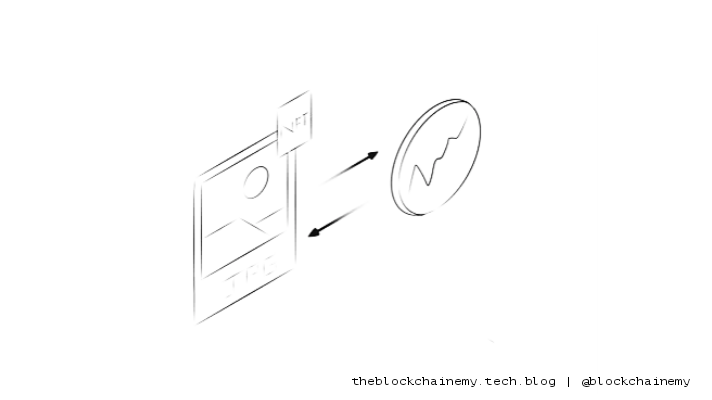
“You can take whatever short video that you created on your phone like cooking tips or tricks, and NFT it. And everyone can do that. So now every hobby that you have and every bit of knowledge that you attain, can be translated quite quickly into monetary value. I think this has the potential to democratize society, as something that everyone can participate in and create another source of income, very quickly”.
Dr. Merav Ozair
You may have heard of Beeple’s digital artwork selling for a record $63.9 million or Twitter CEO, Jack Dorsey, selling his first tweet for $2.9 million.
These, and thousands of other digital asset sales, are taking place in the form of NFTs.
More than $2 million was made in sales when the band, Kings of Leon sold its latest album via NFTs.
So, what are NFTs?
NFT stands for Non-Fungible Token. They’re digital asset (or a token) that you would store in a virtual wallet with other tokens like cryptocurrency.
They run on blockchain technology, the same technology that powers cryptocurrencies like bitcoin.
This means that they cannot be edited or changed. Once created, they exist forever.
With that said, let’s try to explain what fungibility means and the effect on NFTs.
Differences between fungibility and non-fungibility…
Let’s imagine Jane lent Ben $50 in form of a $100 note on a Monday.
And she wants to take it back on Wednesday of the same week.
If she returns on Wednesday to get it, we know that it doesn’t matter if Ben gives her the same $100 note or two $50 notes or even five $20 notes, she’ll accept it gladly provided they didn’t agree on interest, right?
Why?
The notes can be substituted for each other without affecting the value of the money.
On the opposite, imagine I gave you my ATM card to use for a transaction. And when you wanted to return it to me, you brought a different ATM card.
What do you think will be my reaction?
In this case, concerning ownership, the ATM card is Non-Fungible.
Also, in real life, assets like diamonds or land are not fungible as each unit has unique qualities that add or subtract value to the original asset.
Another example, is with real estate.
We know that there are unique features attached to each property.
If you’re a student of Architecture and design of building you’ll discover that part of what is considered during designing includes noise, traffic, wind direction, the path of sunlight, landscaping…
These features make each property unique. And therefore it’s not fungible as it were.
That’s what the power of NFT is. It authenticates each and every asset that you create digital, or even non-digital.
Dr. Ozair
Still on fungibility, “… if I buy a plane ticket, I can’t just pass it on to someone else as it contains information that makes it unique to me and hard to exchange like-for-like, such as my name…,” says the paconsulting website, “… The plane ticket is, therefore, an example of a non-fungible asset.”
One more attribute of fungibility is divisibility.
Fiat cash, and cryptocurrencies like Bitcoin are divisible into smaller amounts like you can receive some Satoshis as the change after paying for a pen if bought in bitcoin.
How Do I Create NFTs?
From our research, it’s clear that although everyone has the potential to create NFTs not everyone is authorized.
Some requirements make it possible for anyone to create NFTs.
One of the requirements is the artwork (picture, video, song…) that needs to be turned into NFT.
When you have an artwork to be transformed into an NFT, make sure your digital wallet has some ether (or the right coin) to power the process.
Then the chosen marketplace.
As Amazon is to online shopping so is marketplace to NFT transactions.
After choosing your desired marketplace, you join the community.
For each marketplace, there’s a procedure for joining the community.
In Foundation MarketPlace, for example, you must be invited to be an NFT creator.
Once invited, you can mint your NFT there.
The minting process makes the digital art to become part of the blockchain on which the marketplace is built.
In this case, the Ethereum blockchain.
So, after choosing your desired marketplace, the next step is…
How do I mint an NFT?
Once you become a creator by accepting the invitation into Foundation marketplace, these are your next steps to mint your first NFT:
- Connect your wallet to Foundation.
Why?
It’s important to note that the NFTs you mint here will be tied directly to your wallet which means that you’re in control of your funds and NFTs.
You connect your wallet to the Foundation.app by clicking on the “connect wallet” pane in the website, then follow the simple processes there like adding your photo, social media accounts…
- Create your NFT
After connecting your wallet, you then use the “Create” button at the top, right corner.
Instantly, a “Create an NFT” page will open.
This is where you can select and upload your raw art work – picture, video, or audio…
- Upload a new artwork
For JPG, PNG, or MP4 files, they shouldn’t be larger than 50MB.
If you’re using still images, a ~3000px width is good while a video file with 1080p or 4K is fine.
For each of the files uploaded, they’ll be compressed to sync with the website requirement.
After you’ve uploaded an artwork (or artworks), your file will automatically be sent to IPFS (InterPlanetary File System – a decentralized, p2p hypermedia protocol built for sharing data in a distributed way) where it stays forever.
- Add a title and description
Just like you do on YouTube or other social media platforms, you’ll need to add descriptions that are relevant to the collections so that collectors can know and understand you and your works more…
… building trust and authenticity.
Caveat: make sure the details included here are correct. Once you sign your NFT, you cannot change any details.
Why?
The immutability of the blockchain technology.
If you want to carry out the update, that means you’d have to burn the NFT.
And guess what that means?
It’ll be destroyed.
- Mint your NFT
If description is accurate, then you can mint by clicking the “Mint NFT” button.
- Sign your NFT
You sign your NFT as your final authorisation that the NFT is yours and the signing is done from your wallet…
… containing ether or any other currency that’s used in the marketplace of your choice.
This signing links your NFT to your Ethereum address and wallet forever showing collectors who the original owner is.
- Approve “Gas Fees”
Don’t worry.
It’s not cooking gas.
“Gas Fees” are the fees paid from your wallet, to complete the mining of your NFT in the Ethereum blockchain.
- Wait for your NFT to be minted
This is where the minting truly starts.
The smart contract runs code to establish the artwork as an NFT on the Ethereum blockchain.
You can also view how much time is left for the artwork to become an NFT.
Another Caveat: Avoid double-minting.
How?
When you approve or click on the “Mint NFT” again and again, you might be doing double minting.
- Minting complete
When you see your minted NFT on your profile, it’s a sign that the minting is complete.
Next question is…
How do I list my NFT for auction?
Read about the process here.
Where can I buy NFTs?
There are lots of places to buy and sell NFTs including NFTify, dubbed the Shopify NFT store, and others.
The worries of NFTs
When NFTs are created energy is consumed. This consumption is paid for as “gas fees” on the Ethereum blockchain.
But “environmentalists” are making cases out of it concerning energy consumption and global warming.
Yet, we’re wondering if the case is truly against energy consumption or the decentralization of “economic power” all over the world.
Time will tell.
Until then, we keep learning about the revolution of the blockchain technology and how to make our world a better place.
 Blockchainemy